The Diversity Dilemma: True Inclusion or Statistical Illusion?
Diversity reports count who gets hired. Inclusion is who gets heard, trusted and promoted.
 Afshana Diya·
· 5 min read
Afshana Diya·
· 5 min read
The headcount is not the story
In 2019 Bangladesh hosted its first ever WordCamp. There were more than 25 organizers. I was the only woman.
That was not new for me. At many tech events in Bangladesh I was the only woman in the audience. When I spoke at a WordCamp abroad, I was the first woman speaker from Bangladesh at any WordCamp outside the country. For years I was also the first and often the only woman from Bangladesh at those events.
So after WordCamp Dhaka I started Women Who WordPress, a women-only meetup in Dhaka. At work I pushed to hire more women. When the first WordCamp Asia came to Thailand, I took my whole team. For the first time, many women from Bangladesh were in that hall. Not just me. Today I watch women from our community attend, organize and speak at international conferences. I am prouder of that than I can put into words.
Every company I know can tell you how many women it hired last year. Very few can tell you how many of them were in the room when the budget was decided. That gap is the diversity dilemma. We have become very good at counting people and much less good at counting whether they matter once they arrive.
I lead marketing for a team of about 120 people across WordPress and Shopify products. I have helped organize WordCamps across Asia and Europe. So I am not writing this as someone who thinks numbers are useless. I am writing as someone who reads those numbers from both sides of the table.
My view is simple. Diversity numbers are a starting line, not a finish line. Many diversity and inclusion reports today are optics. And the answer to bad metrics is better metrics, not walking away from diversity altogether.
The illusion has a name: tokenism
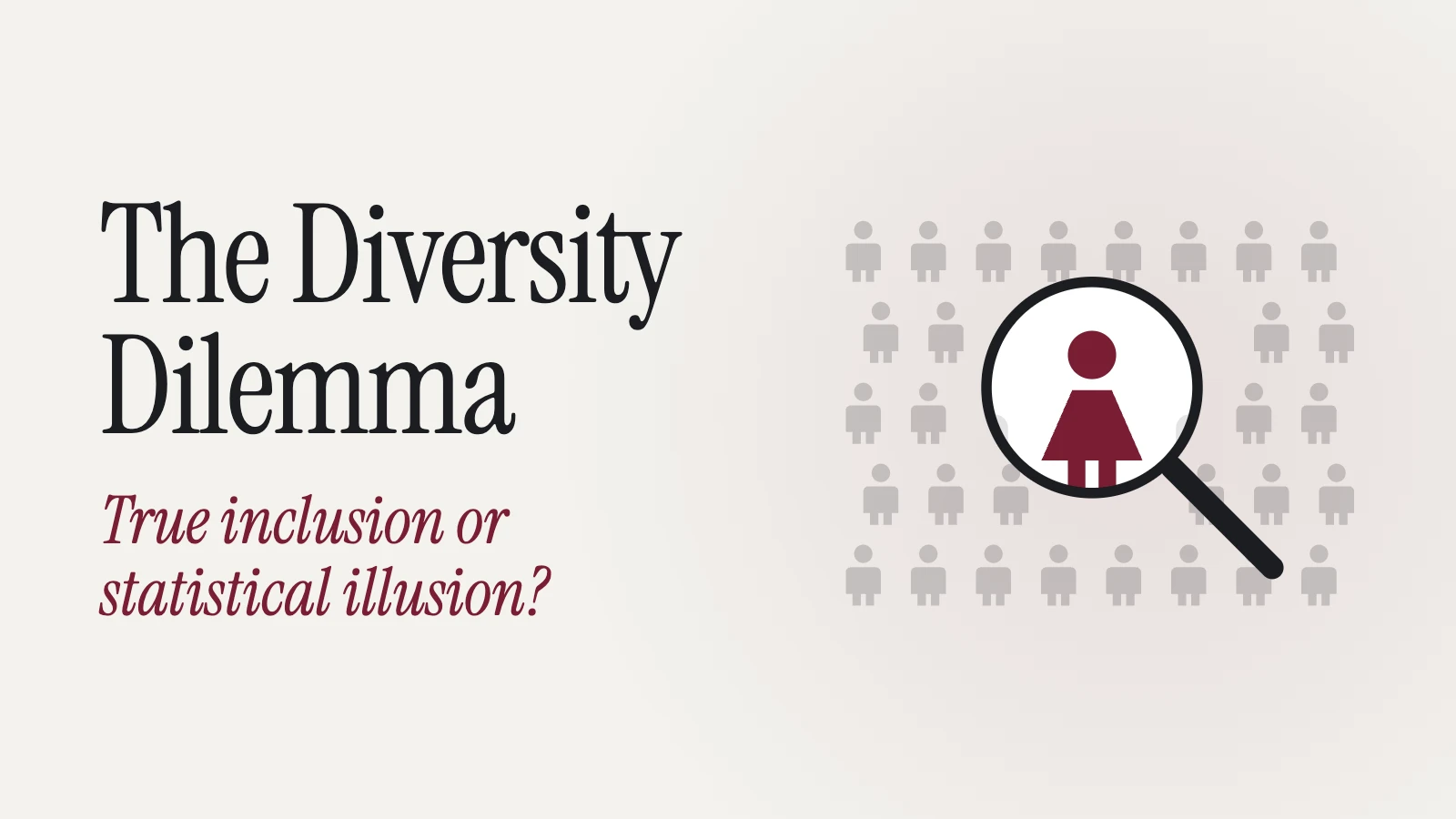
In 1977 Harvard sociologist Rosabeth Moss Kanter studied what happens when one kind of person makes up about 15% of a group or less. She called them tokens. They are watched more closely. Their mistakes are read as proof about everyone like them. And the majority quietly closes ranks around its own habits.
Now look at Bangladesh. A Daffodil International University survey of 384 ICT companies found that women made up only 16% of the country’s ICT workforce. Sixteen percent sits right on Kanter’s line. In much of our industry a woman is not part of the team. She is the team’s diversity.
That is how the statistical illusion works. A company hires three women into a team of twenty and reports progress. On paper the number moved. In the room, three people still carry the weight of representing half the population.
The pipeline tells the same story. McKinsey and LeanIn.Org’s Women in the Workplace research found that in 2024, for every 100 men promoted to their first manager role, only 81 women were. They call it the broken rung. You can hire women at entry level all year and still end up with a leadership team that looks exactly like it did ten years ago.
I have sat on the other side of this too. At many events we organized, we could not find a single woman to speak. So we picked one to fill the slot. She was our diversity pick. It never felt right. Yet look at WordPress events today and the lineups have changed. Other platforms are moving the same way, slower but steadily. The token stage was uncomfortable. It was also where the change began.
Why I still want the numbers
Here is where I part ways with the people cheering the end of DEI. In 2025 Meta ended its representation goals and disbanded its DEI team. Google dropped its diversity hiring targets and started weighing whether to keep the diversity report it has published since 2014. Salesforce, Intel and Uber cut targets or diversity language from their filings (TechCrunch).
Some of that is a fair reaction to programs that were all slogans and no substance. But deleting the number does not fix the room. It only means nobody is checking anymore.
The business case is louder than it is settled. McKinsey’s 2023 Diversity Matters Even More report found that companies in the top quartile for gender diversity on executive teams were 39% more likely to outperform financially. When researchers Jeremiah Green and John Hand applied McKinsey’s method to S&P 500 companies in 2024, they found no statistically significant link. I take both seriously. I just don’t think profit was ever the strongest argument. Fairness is. So is the simple fact that a team of identical people builds products for people like themselves.
The method matters too. Frank Dobbin and Alexandra Kalev studied 829 US firms and found that five years after mandatory diversity training, the share of Black women in management fell by about 9% on average. Mentoring and diversity task forces did far better, with gains of 9% to 30% for underrepresented groups. A compulsory slideshow is not inclusion. A sponsor is.
What true inclusion looks like
Diversity is who gets hired. Inclusion is who gets heard, trusted and promoted. That is the difference between diversity and inclusion. It is also the part most reports skip. These are the diversity metrics I would rather see, including on our own reports:
- Promotion rate by gender at every level, not just headcount
- Who leads the big launches and who gets the visible projects
- Pay gap within the same role and band
- Who speaks and who gets credit in meetings, panels and case studies
- Retention after two years and the honest reasons people leave
- How many women are in the room when budget and hiring decisions are made
In Bangladesh a few more questions matter. Is there safe transport home after a late launch night? Can a woman travel for a client meeting or an international conference without the whole plan resting on her family’s permission? Is remote work treated as a perk or a penalty? None of these show up in a headcount. All of them decide who stays.
At WPDeveloper we have tried to offer more than equal opportunity. We try to close the gap. Women lead our marketing and QA teams. Women sit at the table where HR decisions are made. Our female colleagues get extra benefits and their own wellness zones. Equal treatment on day one does not undo years of rooms built for someone else.
Count what counts
Numbers can get women through the door. They will not keep us in the room. That is the job of leaders who are willing to measure the uncomfortable things: who is growing, who is heard and who quietly leaves.
So here is my challenge to every founder and decision maker reading this, starting with me. The next time you share a diversity number, put the promotion number next to it. If the second one is embarrassing, good. That is the real report.
Sources
- Kanter (1977), tokenism and the 15% threshold
- The Daily Star: Of the ICT workforce, only 16% are women (Daffodil International University survey, 2019)
- Fortune: the broken rung, 81 women per 100 men promoted to manager in 2024
- TechCrunch: tech companies rolling back DEI (April 2025)
- McKinsey Diversity Matters Even More (2023), summary
- Personnel Today: Green and Hand replication, Econ Journal Watch 2024
- Harvard Business Review: Why Diversity Programs Fail (Dobbin and Kalev, 2016)
Co-founder of xCloud, CMO of Startise and Local President of JCI Dhaka Founders. 55 countries with a Bangladeshi passport.


